Latest Posts

peach and mint sangria

Welcome, all ye who love summer. The heat of it. The gleam of it. The relaxed, open sensation of it. It’s the time of year when you become “holiday you” and then try and take that person through to the rest of the slightly colder, more insular months. The one who walks barefoot and laughs full-throated at cobbleside tables. Who packs picnics and hopes for fair weather, head tilted upwards, instead of checking the weather forecast. Who throws on a pair of sandals and sunglasses and calls it a day, letting the sunshine melt away your flaws.

This is the drink for you. Make it up the night before and leave it in the fridge – when you’re ready to greet the sun, it’ll be ready to go with you. It’s refreshing, fruity, and packs a summer punch. That is to say, you’ll be happy sipping this on a picnic blanket with good friends – and no other plans.

It goes without saying, but use the freshest ingredients you can. During the summer, peaches are everywhere, drippingly delicious and messy. You lick the juice from your fingers, wipe it, sticky, from your chin, and keep on going until you hit the kernel. And even then you try and worry off those last perfect, sweet, almost buttery-zingy morsels from the honeycomb traps of the kernel itself. At least I do. For this, admittedly, you’ll want to avoid using teeth – a sharp knife and an undaunted approach, when it tries to ooze everywhere, is necessary. Mint lends it a top note, peach gives it a fuzzy warm middle, and the booze gets you right in the good place.

Drink on, my friends, and enjoy the sun. Tomorrow belongs to someone else.

peach and mint white sangria
Serves 4 happily, or 2-3 generously

1 bottle fruity white wine
4-5 tbsp caster sugar
1 apple, diced
3-4 peaches, sliced
A few sprigs of mint

Find a container that will happily sit in the fridge, sealed, and add to it a diced apple, 4 sliced peaches, and a few sprigs of mint. A jug or a plastic cereal container that will fit in the door of the fridge is perfect.

Sprinkle the sugar over the fruit and mint and toss it all together to distribute it.
– A word on the sugar: if you’ve selected a very sweet wine, you won’t need all the sugar. Take a sip of the wine before you start and try to gauge its sweetness. If unsure, start the recipe with 2-3 tbsp and add more at a later stage if it needs it.

Pour over the wine and stir. Cover and leave the sangria in the fridge for a few hours or, even better, overnight. When you’re ready to serve (it’s best chilled), decant it – fruit and all – into a jug. Grab a few glasses and some summery nibbles, maybe a few ice cubes if the day is particularly warm, and enjoy.

spiced carrot and chickpea salad

This is a salad for a day when you need nourishing, but you also need a bit of heft. The chickpeas lend the dish a reassuring, creamy, nutty weight, while the carrots offer crunch and sweetness. The earthiness of the spice is balanced by the zing of fresh citrus and mustard and, over it all, a sprinkle of grassy parsley; a delightful colour contrast, as much as a flavour complement.

You can eat this on its own (and I have), but it’s lovely as part of a mezze spread. Or on the side of some grilled aubergine with a dollop of hummus for good measure.

The below recipe uses canned chickpeas for speed and convenience, but dried chickpeas beat it for taste and texture by a mile. If you’ve got the time, soak 100g dried chickpeas overnight in plenty of water with a large pinch of salt. The next day, drain them and put them in an oven-safe pot with a lid (a cast iron casserole, for example), cover with plenty of water, a teaspoon of salt, and any aromatics you fancy chucking in (half an onion, a few sprigs of thyme or parsley, the odd garlic clove – whatever you have lying around will do). Put the pot, with the lid on, in a low oven, around 160°C, and cook for 90 minutes to 2 hours. The exact cooking time will depend on the age of your chickpeas so start checking after an hour has passed. You want to take them out of the oven when they’re tender. While you don’t need the cooking liquid for this recipe, hang onto it – it makes a great flavour base for a soup (just use it as you would stock). Drain the chickpeas and use as instructed below.

spiced carrot and chickpea salad
Serves four, happily

Salad
400g can of chickpeas, drained and rinsed
250g carrots, peeled and grated
Flat leaf parsley, chopped

Dressing
1.5 tbsp fresh orange juice (e.g. ½ orange)
1 tbsp fresh lemon juice (e.g. ½ lemon)
½ tsp Dijon mustard
Large pinch each of ground cumin, ground coriander, and fine salt
2 ½ tbsp extra virgin olive oil

Make the dressing in the base of your salad bowl. Add the fresh juices, the mustard, and the spice and whisk it all together. Drizzle in the extra virgin olive oil and whisk again until a smooth, creamy sauce emerges. Alternatively, put all the dressing ingredients in a clean jar and shake it all into submission.

Add the carrot and chickpeas to the bowl and gently toss to combine. Have a bite (go on…) and adjust the salad to your taste. It might need a pinch more salt, or maybe the lift of another squeeze of lemon. Tailor it to suit you.

Garnish with the freshly chopped parsley and serve.

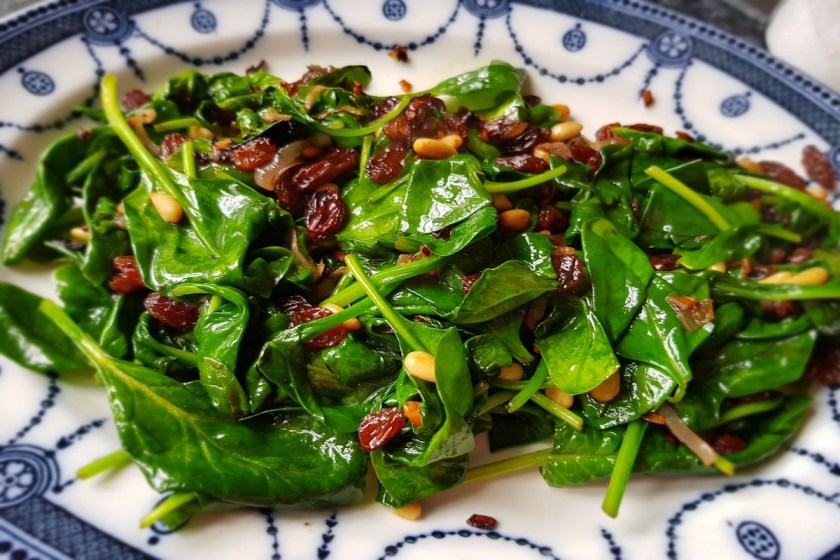
catalan spinach

Spinach, pine nuts, red onion, raisins. It’s a simple list of ingredients and it’s simplicity itself to combine them – which is why this isn’t so much a recipe as it is a guide – but the result far exceeds any such “simple” expectations.

Salty. Sweet. Slicked with extra virgin olive oil and studded with nuts. This dish comes together in minutes and is devoured just as fast. We first had it at a restaurant – me nursing a chilled, bone-dry sherry and J a thick, hearty red wine – while we were working our way through small plate after little dish before a late evening at the V&A. But while the cured meats were lovely and the cheese, as cheese is wont to be, delicious, it was this spinach dish that stole the show.

I’m probably not the only one who wants to recreate food. To chase after tastes enjoyed at other people’s tables, whether in homes or restaurants. And not all my attempts have been winners. I’m still particularly haunted by the gnocchi, swathed in a lavender-butter-parmesan sauce, that I ate in Rome several years ago. I’m still no closer to figuring out how to make the dish than I am to remembering where I ate it. Usually so fastidious about noting down names, I seem to have simply stayed in the moment, transfixed by the meal and the wine and the good book. The perils of a solo trip is only one set of eyes and one unreliable notebook. But I digress.

Happily, this dish was easy enough to recreate because it’s a simple bringing together. Each ingredient holds its own and contributes a little of itself to create a fantastic whole.

We’ve been known to eat this on its own. Or topped with a fried egg and accompanied by some bread for mopping. But it’s a real cracker on the side of fish. It would even make a fantastic filling, should you feel like stuffing a whole fish and grilling it.

Catalan Spinach

Slice half a red onion into thin half moons and move around a sauté pan warmed over a medium heat and slicked with extra virgin olive oil. Add a pinch of salt to encourage the onion to soften and yield. A shallot also works well here, if that’s what you have.

Don’t let the onion brown, so if it’s starting to really sizzle, lower the temperature. Add the pine nuts and raisins. A little handful of each will suffice. If your raisins are of the tough, obstinate kind, a few minutes soaking in a splash of boiling water before tossing them in the pan will plump them up a bit.

As the pine nuts gather a bit of colour (we’re looking for gold, not brown here), start adding the spinach. A few generous handfuls will probably be enough. Drag the spinach around the pan so that it starts to wilt and then heave the whole lot out of the pan and onto a serving plate. You don’t want the spinach to collapse entirely, it should still have some leaf-ness to its shape.

Take a bite. Maybe add a little more salt if it needs it. Maybe move things around so some of the nutty, fruity jewels sit atop the green. Or just grab a fork and go to town.

early morning at the mercado central de atarazanas

Mechanical, beautiful, merciless. There they stood, gutting and chatting, fishmongers all, masters of their craft, placidly ignoring the one or two mad people (hello) early enough to have arrived at the Málaga food market – the Mercado Central de Atarazanas – before the day’s wares were unboxed, the shutters rolled up, the fish disembowelled. They couldn’t give two figs that we were there. They weren’t going to rush; this is just how their days start. An easy flick of the wrist and the prepared anchovy whizzes into the box. New fish. Practised movement. Mind hardly on the task, more focussed on the chat, which, of course, we couldn’t understand – or look away from.

We were meandering through the market, staring openly. The language barrier somehow making us invisible, or so it felt as we gaped, openly, at the links of chorizo, dangling from hooks. The huge heads of swordfish, de-bodied and staring at the metal roof, pointing their rapiers to the sky. Fuzzy sunset-coloured peaches. Gleaming red, yellow, green tomatoes. Tightly packed Padrón peppers, bundled, waiting to be seared and sprinkled with salt back home.

A fishmonger upended a bucket of prawns with a whoosh, sending them skidding across the white marble countertop, bouncing off shards of ice, skittering off in multiple directions. His container upended, he placed it down and reached out as if to gather the delicate pink prawns into his strong, downy arms, only to slide them to his left; room must be made for the langoustines. Another bucket appeared. Another pink-grey deluge commenced.

Another stall was all about shellfish. Razor clams and winkles amidst types we’d never seen. Partitioned and perfect. Closed shells in shades of seabed, sand, and slate. Moving around the corner we found a miniature stall, not much more than a rickety white chest freezer. As the man slid back the lid, I half expected to see ice creams wrapped in foil. Instead, layers of creatures and crustaceans, arranged almost archaeologically in the ice, waiting for someone to send the stall-runner a tentative “pulpo?”. Diving beneath the cardboard shelves, pulling outside the packages and parcels of all sizes and secrets, he unearthed a small, round ice-tinged purply cephalopod with a triumphant grunt and a raised eyebrow.

A few laps later, my eyes landed on a few boxes in the far corner. Fresh herbs, perhaps? Finally? A teenage boy on his summer holiday (I presume) was there, stacking and grabbing with his too-big-for-him gloves. Moving bundles from one place to another. I pointed, energetically, at the bottom box, the Spanish for “mint” escaping me entirely. Gesturing and half phrases ensued, from him and me, before a big no-nonsense bear of a man appeared from behind the back wall of boxes to deftly unwrap a bundle, the smell of fresh damp mint escaping briefly, before pirouetting behind me to hand it to the greengrocer, who weighed, bagged and reached out for the requisite Euro. Quick, practised, graceful. Seemed I’d inadvertently found the herb man, delivering to the stalls who stock them, before his rounds. All the bunches still wrapped in brown, crochet-looking cloth.

Purchase made, we emerged, smiling, smelling cleanly of mint, and step out in the sunshine, blinking at its fierce 8am blaze, and off to cook.

wild garlic pesto

There are many ways to make wild garlic pesto. Some recipes will have you blanching the wild garlic leaves for a few seconds, others will have you just blitzing everything together. Some are more traditional, suggesting you use a pestle and mortar. Others tout the simplicity of the food processor. Some will specify how much wild garlic, by grams, you need. Others will encourage you to mix up the nuts, swapping out pine nuts for hazelnuts and walnuts. But you know what? They all taste good. The main thing you need to remember is taste as you go, and you’ll create something wonderful. After all, with an ingredient like wild garlic, it’s hard to go wrong.

Wild garlic grows, as you might imagine, wild from March to June, so you can forage it by the basketful, if you’re lucky. My school used to be blanketed with the stuff in the spring. But did I make use of it? Was I even aware of it, beyond the warm pungent smell of garlic everywhere we walked? No. More fool me. Now, it’s hard to find anywhere near me. Alas. Until, of course, I found one bag of it left at Stalks and Stems in Glasgow’s West End. It was like urban foraging (I paid for it, don’t worry – I didn’t take “foraging” that literally) and it was no less satisfying for it. In fact, I was so happy when I spotted it that I grabbed it and, out loud, said, “MINE” to no one in particular.

And then I got to thinking about what to do with it. So far we’ve had it sautéed in butter and served alongside a large cooked breakfast, on toast, and in pesto. Pesto does make incredible use of it – and pushes its longevity, which is no bad thing.

This is a rough recipe, based on one that appears in a few places, including Great British Chefs and this great article on what to do with wild garlic from The Independent. Most recipes cleave to the same essential principles, however, using a handful or two of wild garlic, equal amounts nuts and parmesan (about 50-60g), and adding olive oil, salt, pepper, and lemon. Ultimately, it’s a matter of taste – both in terms of seasoning and punch, and consistency.

wild garlic pesto
makes a good-sized jarful

2 handfuls wild garlic
1 handful flat leaf parsley
60g lightly toasted pine nuts (just enough to tinge them golden and release their nuttiness)
60g parmesan
Olive oil (a mixture of extra virgin, and mild olive oil)
Squeeze of lemon, salt and pepper, to taste

Blitz the wild garlic, parsley, parmesan and pine nuts together in a food processor until you get a thick paste. Stop and add a pinch of good salt and freshly ground pepper, and a squeeze of fresh lemon.

Whack the food processor back on and start drizzling in the olive oils. A blend of the two kinds of olive oil gives you just the right balance – the peppery grassiness of the extra virgin tempered by the milder stuff.

By the way, some recipes call for about 300ml of oil (150ml of each), but I say, just pour it in slowly until you get the consistency you like, pausing every now and again to dip your spoon in and see if you like what you taste. Does it need more of a top note to balance the pungency of the wild garlic? Add a bit more lemon juice. Does it need a bit more salt to help it sing? Or do you want to add more oil so that it’s a looser mixture? It’s up to you!

When you’re happy, decant it into a clean glass jar and use within a few days, or freeze it and it’ll last a couple of months.

Speaking of freezing: if you’ve found a bumper crop of wild garlic, do what we’re doing and make an extra batch to freeze. Just spoon it into an ice cube tray (one you use for savoury purposes, like flavoured butters, or one you don’t mind donating to this garlicky cause) and freeze. You can leave it in the tray once frozen, or tip them out into a freezer box/bag. That way, when you want a hit of wild garlic, you can just grab the amount you need (e.g. a few cubes at a time).

Another way to give your wild garlic a longer shelf-life would be to finely chop and beat it into some butter and freeze the same way. If you’re using unsalted butter, add a pinch or two of good sea salt, or just use salted. A few minutes work now while wild garlic’s in season means instant springtime flavour whenever you have a hankering.

Wild garlic pesto is delicious tossed through hot pasta (remember to reserve some of the pasta cooking water to help distribute the pesto and emulsify it, giving it a smooth, silky texture, rather than one that’s dry or starchy) or freshly-cooked gnocchi. You can spread it on crunchy sourdough toast and top it with anything from ricotta to hot smoked salmon. Or stir it through boiled new potatoes for a seasonal twist on a potato salad or mix it into a white bean gratin. Ah, the possibilities. Enjoy!

cured lemons

My pickling and preserving ambitions have now exceeded the limitations of my fridge.

There are jars of dilly pickled carrots. Homemade limoncello. Seville marmalade, of various sorts and peel stripes (grapefruit, lime, blood orange – oh my!). The old bars of my fridge shelves are sagging under the weight. And I can’t stop. There are too many things to make.

One of my favourites, which has been out of commission for a while, are the cured lemons from The Palomar Cookbook, gifted to me a few Christmases ago by my brother and his girlfriend.

The Palomar itself is a restaurant in London serving the food of modern Jerusalem, by way of North Africa, Spain and the Levant. And the book – a labour of love, with input, recipes, and techniques from different members of the team – is a collection of some of the restaurant’s great dishes. Some you might recognise, like labneh and fattoush, others you might not, but you’ll soon clamour to make, like the scallop carpaccio with “Thai-bouleh” (which swaps out lemon for lime and bulgur for cashews in the traditional tabbouleh salad).

The cured lemons, meanwhile, are the first recipe in the book – it’s a bold opening. And it’s quickly followed by a recipe for a spicy paste made with them, packed with chilli, paprika and cumin, which makes an argument for whipping up a batch of cured lemons using the original proportions (it calls for 10 lemons).

But for my purposes (not being a commercial kitchen, and having the aforementioned lack of space), I’ve adjusted the recipe to make a smaller amount, but it still makes one generous jarful – and a delicious one, to boot. I’ll include the original proportions at the end, if you want to make a bumper batch.

While the slices are wonderful in place of any preserved lemon requested by a recipe, I’m particularly partial to a few slices simply chopped up and eaten on their own. Tart and salty, they make a wonderful apéro snack, especially when accompanied by some earthy nuts and a few slices of salami. They cut through the wide taste of the fat, waking up your taste buds and giving you that toe-tapping taste sensation.

Of course, not everyone has my love of sharp, zingy things, but they’re still an invaluable addition to the fridge larder. The lemons themselves have the obvious uses, from pilafs to tagines, but the salty, lemony oil that the slices are preserved in make delicious salad dressings. It’s a particularly great addition to tzatziki, adding an extra dimension to the creamy, fresh, herb-packed dip.

You need unwaxed lemons for this as you’ll be eating the rind. But in a pinch, you can buy waxed ones and give them a good scrub under warm running water to get rid of the coating. But my advice would just be to wait until you can buy some lovely-looking unwaxed ones, if you can, and save yourself the extra work.

cured lemons
adapted from “The Palomar Cookbook”

4 unwaxed lemons
24g Maldon salt
80ml light olive oil
70ml extra-virgin olive oil

Sterilise a large glass jar. For tips on how to do this, read this article.

Cut the lemons into slices of about 5mm (or about the thickness of a pound coin).

Place a layer of lemon slices (or as best you can, depending on the width of the jar) in the jar, then sprinkle on some of the salt. Repeat until all the slices and all the salt is in the jar.

Using one measuring jug, measure both kinds of oil and pour them over.

Seal the jar, and put in the fridge. The slices will be ready to eat in three days, and will keep for up to a month in the fridge.

Notes:

  • The original calls for 10 unwaxed lemons, 60g salt, 200ml rapeseed oil and 175ml olive oil.
  • Keep these in the fridge to get the most bang for your buck, but if you can find a cool, dry spot (out of sunlight!), then they’ll last around a week.
  • The oil measurement is a guideline – in fact, so are the lemons. Much will depend on the size of jar you choose. So, slice up the lemons, layer them in, sprinkle the salt, pour over the oil, and you’ll probably be alright. But just make sure, whatever proportions you use, that the lemon slices stay covered in oil. Add a bit more if necessary.
  • To keep these delicious for as long as possible, remember to fish them out of the jar with a clean utensil (or a pickle fork – incidentally, mine’s an ornate silver one, a gift from my parents, which looks, fabulously and, I believe unintentionally, like someone giving the finger) so as not to contaminate the lemons and their oil.

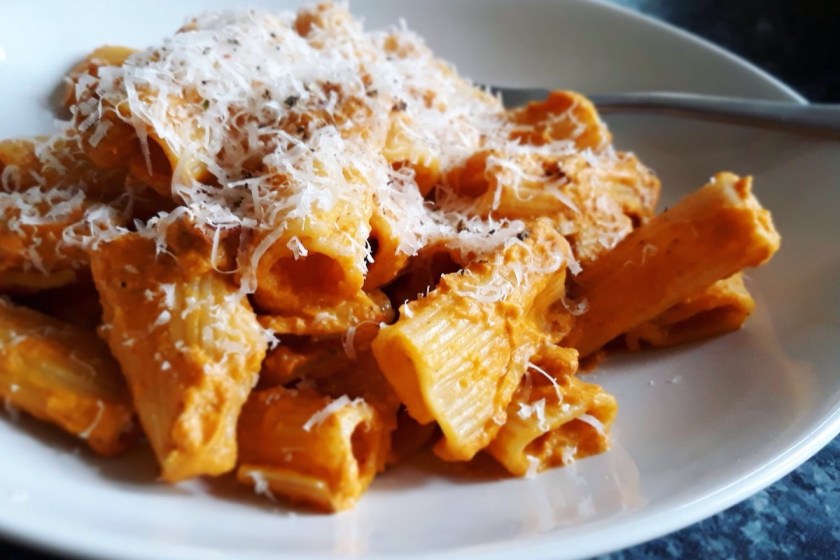
creamy pumpkin rigatoni

At this time of year, I invariably have odd half cups of pumpkin puree leftover from making pancakes, waffles, and the like. This year I even played around with a pumpkin pie ice cream, which was, in the end, really rather tasty. So a pumpkin overflow isn’t exactly the worst problem to have. In fact, come lunchtime, it’s often the best ingredient for a fast, seasonal and, most importantly (at least on cold, dreary days), warming meal.

This takes about as long as your pasta takes to cook. While it bubbles away, you can hover near the stove assembling and stirring the sauce, and enjoying the balmy heat of the kitchen (a boon when your flat refuses to acknowledge that the heat is on full whack).

You’ll notice that much of this is “to taste” – from the amount of nutmeg to the parmesan. Embrace that. Grab a spoon and taste as you go. After all, the oven’s on and it’s a nice warm place to be. Maybe you want your pasta extra cheesy today? Or maybe you’d like a bigger hit of nutmeg because you’re feeling the seasonal spirit. Go with what tastes right to you. That’s part of the fun.

By the way, while this does have bacon in it (as many of the best things do), it’s easy enough to remove and make this dish vegetarian.

Right now, the sky is dark, the grass is damp, and there’s a wonderful whip to the wind as it whistles round my flat, tucked within a lovely rusty-red brick building. It’s mid-morning, and the world is telling me to stay in, keep warm, and make a big bowl of creamy, spicy, rich pasta. And you know what? I’m good with that.

creamy pumpkin rigatoni
serves two

250g rigatoni (or any other pasta of your choice)
1 tbsp butter/1 tsp mild olive oil (or any other neutral oil)
3 rashers of smokey, streaky bacon (or a small pack of lardons/pancetta)
2 garlic cloves, crushed
1 cup of pumpkin puree
1/4 cup double cream
Nutmeg, cayenne, parmesan, and pepper, to taste

Cook the pasta in plenty of salted boiling water. You want to do this first because the starchy cooking water is an ingredient in an early stage of the sauce.

Warm the butter and oil (the oil will stop the butter burning) in a decent sized frying pan over a medium heat and add the bacon, if using. When golden, but not crisp, add the crushed garlic and quickly stir through before adding the pumpkin puree. You don’t want the garlic to brown or burn here, otherwise it will taint the otherwise smooth, rich taste of the sauce.

Turn the heat down low under the sauce and stir. Add a 1/3 cup (about 80ml) of the starchy pasta cooking water and leave it alone for a bit. The final stages (seasoning and cream) will happen when the pasta is basically cooked, so just keep an eye on the sauce, and if it looks like it’s getting dry, add a bit more cooking water.

When your pasta’s al dente, remove at least half a cup of cooking water. This is your pasta safety net, you might not actually use it, but there is nothing worse than dry pasta, especially when it can be so easily rescued with just a splash of this magical liquid, which can turn even the most reluctant sauce into something smooth and luscious.

Taste the sauce, then grate in a small amount of fresh nutmeg and add a pinch of cayenne, to give it a little heat. If you like things spicy, by all means, up the cayenne quotient. Then grate in a generous shower of fresh parmesan. Stir together and pour in the double cream.

Taste the sauce again and grind in some fresh pepper. Unless you’re a serious salt fiend, I doubt you’ll need to add any as both the bacon and the parmesan offer salinity. But if you’ve removed the bacon, you might want to add a pinch here.

Drain the pasta and either add it to the sauce, if you’ve got room in the pan, or return it to the pasta-cooking pan and pour over the sauce. Basically, you’ll need a good amount of space to properly stir the sauce and pasta together (otherwise it’ll end up all over your hob) to distribute all the bright orange, pumpkin-y goodness. That’s why rigatoni’s so good here – there are so many places for the sauce to wind and wrap itself around.

For the next bit, go by eye – the sauce is creamy but thick, so if you think it could use it, add a little of the reserved pasta cooking water to loosen and make it a little more silky. I almost always add about a tablespoon of liquid at this stage.

Then dish the pasta up and serve it with an extra grating of fresh parmesan and a little more freshly-ground pepper. For the full cosy effect, grab a blanket, and head over to the couch with your seasonal spoils, and watch some TV as you munch.

duck and bulgur salad with feta

Packed full of herbs, earthy from the bulgur, with a slow sharp slap of creamy zing from the feta, this is a memorable salad that’s just right for this time of year. It’s been, as the Scots say, dreich for days now. Low grey skies and clumps of wet leaves as far as the eye can see. But I love this kind of weather. It smells good outside, fresh, like everything’s getting a good scrub. Getting right to the quick.

Finding myself in need of a lunch for one, and a break from work, which was causing me not a little amount of stress, I decided to bring together a few ingredients for a nourishing meal. To take a proper break to make something that would taste good and make me feel great. The result is an autumnal meal, slightly nutty from the fine brown bulgur, and rich from the duck, but one that’s light and fresh nonetheless. A meal that makes the rest of your day feel full of promise.

I don’t recommend cooking the duck from scratch for this – instead, it’s the perfect way to use up leftovers. After all, part of the delight of duck is the crispy skin and that would be wasted here (it’s better sneaked off in fatty shards while no one’s looking). So, cook yourself some duck – a roast, a Peking duck to have with pancakes – and enjoy it in its hot meaty splendour one night (or buy it ready-cooked), and rest assured that your leftovers tomorrow will be likewise as tasty. Or substitute lamb, if that’s what you’ve got; it would also be beautiful here. For a veggie version, some roasted and cooled aubergine would be great.

This makes a generous bowlful for one (eke it out for two as a side, just omitting the duck, or double the quantities to spread the love). It doesn’t feel heavy, hefty, or ‘too much’ – no, it’s a Goldilocks bowl of goodness to sate and satisfy the soul on a grey day. Enjoy.

duck and bulgur salad with feta
for the salad

1/4 cup of fine brown bulgur wheat
1/2 cup of boiling water (plus 1/4 tsp fine salt)
2 slim spring onions
small chunk of cucumber (8 cms or so if you want to be precise), finely diced
1 tbsp dried barberries (soaked for a few minutes in 2 tbsp boiling water, then drained)
leaves from 4-5 sprigs of mints, sliced or chopped
leaves from 4-5 spring of flat leaf parsley, sliced or chopped
30-40g of duck meat (e.g. roughly the amount from a well-looked-after duck leg)
50g feta
salt and pepper, to taste

for the dressing

1 tbsp extra virgin olive oil
1 tsp lemon juice
1/2 tsp pomegranate molasses
1/8 tsp each of ground cumin, coriander, and ginger*
small pinch of cinnamon, small pinch of salt

*basically, a generous pinch of each

Pour the salted boiling water over the bulgur in a heatproof bowl. Cover with clingfilm and leave to rest and absorb while you assemble the rest of the salad (10-15 minutes, roughly).

Make the dressing in a generous mixing bowl (one that you’d feel comfortable tossing all the ingredients in) – adding all the dressing ingredients and giving it a brisk whisk. Then pour the boiling water over the barberries in a small separate bowl so they get a little more hydrated. This doesn’t need to be for long (a few minutes), just so they’re plumper, and not tight little nubbins.

Finely slice the white (and a little of the light green) parts of the spring onions, pull the meat off the duck bones, dice the cucumber, and gently slice the herbs. To do the later, I tend to lightly bundle them together (like a cigar) and slice in a very rough approximation of a chiffonade. Leave these on your chopping board for now.

After 10-15 minutes, check that your bulgur wheat has absorbed all the water. Give it a fluff through with a fork to separate the grains. Add the ingredients on your chopping board (springs onions, duck, cucumber, herbs) and toss through with your fork.

Tumble the contents of the bulgur bowl into the larger bowl with the dressing. Gently toss everything together (the dressing is not excessive – each morsel is lightly dressed, not drenched so don’t rush this). Top with crumbled feta, devour.

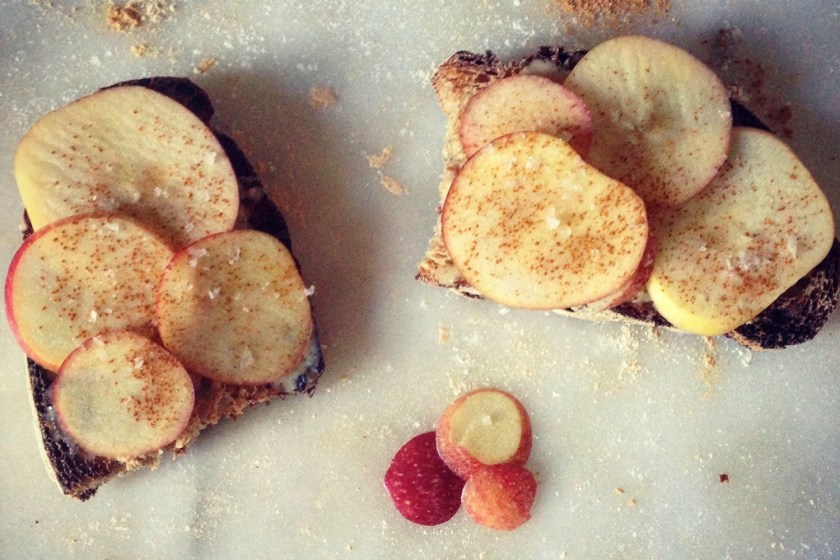
tahini toast with apple and cinnamon

This is one of my perfect autumn breakfasts. And although I’m writing about it here, it’s hardly a recipe. More of a suggestion of how to assemble a pretty cracking piece of toast.

Basically, spread some good sourdough toast thickly with tahini, layer on some thin (thin) slices of fresh apple, and then sprinkle it all with ground cinnamon and crunchy Maldon salt.

Eat with a hot cup of coffee alongside and just wait – everything in the universe will align in that bite, and everything will feel good, and warm, and autumnally-suffused with spice.

This is a simple dish, and as such, you will taste all the elements involved. That’s kind of the magic. You get the crunch from the bread, and the savoury pop from the snowy flakes of good salt (hello, Maldon, you delicious beast). The warm freshness of the apple balanced by the smooth nuttiness of the tahini. And then cinnamon wrapping it all in scent and spice.

So, pay attention to what you use. Starting with the bread: I would recommend sourdough, and homemade if you can stretch to it (I’m a convert); it makes fantastic toast. But really, any kind of toast will do – as long as it stays crunchy. Basically, you don’t want anything that might go soggy under the tahini, and your average supermarket loaf will do that. If you don’t have ready access to sourdough, try a cob or country loaf.

And the other thing is to use the best quality tahini you can find. Now, this does not mean expensive. Actually, I’ve found that the average stuff found in supermarkets in small glass jars is more pricey. And worse yet, it’s claggy and, more often than not, bitter. No, just find yourself a good international supermarket/grocery shop and get yourself a tub of the good stuff. I particularly like the Lebanese brand, Cortas, which is silky smooth and fabulously nutty. It’s so good that part of the fun of making this breakfast (aside from actually eating it) is licking the tahini spoon mid-assembly… But if you can’t find it near you, they stock it on Sous Chef, along with Al Taj, which is another good brand.

So, there you have it, kind of. This is an autumnal breakfast that requires very little effort, but packs a wonderful flavour punch.

A few final things:

  • If you were wondering how much of the cinnamon and salt, I’d say a decent pinch of each, but it does come down to personal taste. Just don’t go crazy on the cinnamon – a gentle sprinkle will give you all the flavour you want, without the oddly floury effect that an excess of ground powder has.
  • A mandoline is great for getting thin slices of apple, but a sharp knife will do just fine. Leave the apple whole and slice on one side until you can near the core, then start on the opposite side of the apple and repeat. That way you get lovely round slices of apple. That’s what I like to do anyway!
  • If you’re not a fan of fresh apple, try it with a crisp pear instead. Also delicious.

chapter 5: a seasonal shift

Hello, autumn, and hello to –

sharing a plate of pumpkin cinnamon rolls with family, hot from the oven and drizzled with cream cheese icing – sticky, sugary, good

soup, made with hearty grains and meats, more brothy, light – it’s not winter yet

the heady scent of cinnamon – a pinch in a pot of coffee before it’s brewed, imparting mellow, memory-rich spice

lighting candles for a breakfast of yeasted waffles with cinnamon-sugar-roasted figs and vanilla-olive-oil yoghurt – stolen moments before the day really starts

conker spotting – kicking leaves – digging out woolens – buying soft socks

being wrapped in a heavy dressing gown on chilly mornings, padding over to the boiler in soft socked feet to flick the heat on – not yet necessary, but nice

new stoneware mugs, perfect for petite cups of steaming hot coffee – held lovingly by hands wrapped in warm Dijon-coloured fingerless gloves

the crisp bluster of Glasgow air and soft pink-blue sunsets, best seen from the top of the Lighthouse or the viewpoint at Queen’s Park – colourful and clear

baking bread to warm the kitchen, sending a soft yeasty smell through the flat, lending warmth to drafty corners – and the knowledge of a treat to come, crackling and soft, thickly spread with butter and a sprinkle of Maldon salt

filling shopping baskets with squashes of all shapes, sizes, and colours and lugging them home – dotting some around the kitchen, stuffing and roasting others

reaching for thyme, rosemary, and sage – a darker resin-richness for cooler nights

the perfect golden autumn light on walks through the park – wrapped in a hat, scarf, gloves to keep off the bracing whirl of wind

a season of mulberry – gold – brown – russet

and, here’s hoping, a season of good things.

– Giv