Latest Posts

Maya Angelou’s lemon meringue pie

I found myself awake and at my kitchen table at 6am this morning – and a Sunday morning, no less. After making coffee and toast, I sat at the kitchen table to read Hallelujah: The Welcome Table, Maya Angelou’s book of recipes and memories. And I read the whole thing – barring, of course, the hour and a half that I’d driven around London (driving lessons in the city, I find, are better when no one else in their right mind is awake and on the roads). So before most of the city was even awake, I’d concocted a plan to make Maya Angelou’s Lemon Meringue Pie.

Having not really made pie many times before, let alone one that involved not only pastry, but lemon curd AND meringue, this was a bold decision to make before 9am on a Sunday. But I loved the story that went with it and I had a desperate desire to know what it tasted like. And that’s good enough for me.

Maya Angelou’s Lemon Meringue Pie

Ingredients
Pie

200g caster sugar
3 tbsp cornflour
⅛ tsp salt (I went with a hearty pinch)
350ml hot water
75g breadcrumbs*
4 large eggs yolks (keep the whites for the meringue)
1 tbsp butter (I actually forgot to put this in… but still tasted nice!)
Zest of one lemon
Juice of two lemons
Shortcrust pastry (No judgement here if you make or buy yours–today I used store bought… Please don’t judge me either! J was doing the ironing – and since he’s the pastry dude in this house and this was a sleepy, lazy Sunday, after all, it just seemed easier to buy it.)

Meringue

4 large eggs whites
⅛ tsp salt (again, a hearty pinch)
1 tsp lemon juice (originally: 1 tsp cream of tartar**)
4 tbsp caster sugar

*I used the soft white insides of a little french stick. This worked really well, although I did need to strain the mixture part way through to get rid of the odd lump. Incidentally, I then blitzed the french stick in the food processor to make breadcrumbs for fried green tomatoes (recipe to follow).

**Ordinarily cream of tartar is used to stabilize the egg whites for making meringue, but with this being unavailable to me on a Sunday morning in my neighbourhood, I went with 1 tsp of lemon juice, which works in much the same way. And saved me some money, to boot!

Preheat the oven to 200°C (400°F/Gas Mark 6).

The recipe calls for a double boiler – this is essentially a bain marie, so place a heatproof bowl over a saucepan of boiling water, making sure the bowl doesn’t touch the water.
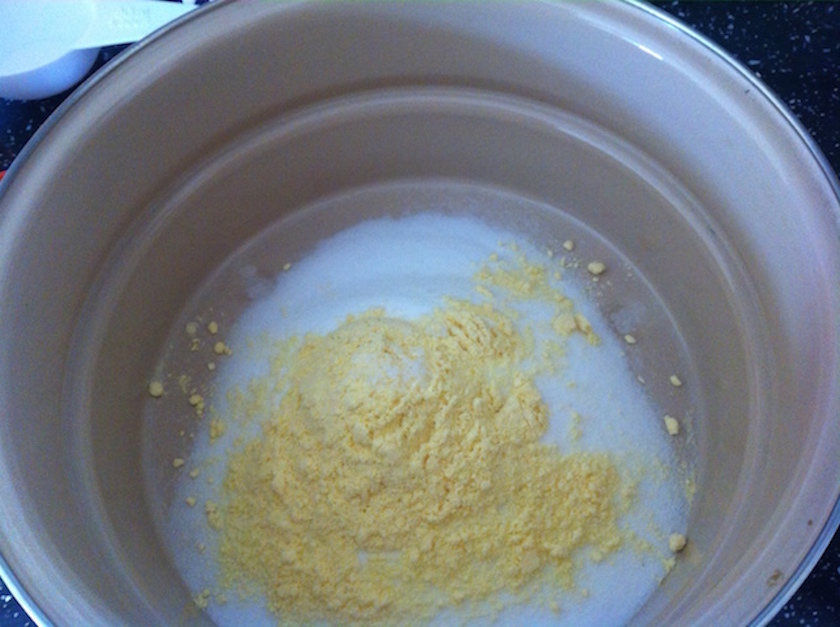
photo 1

Cornflour, sugar and salt pre-mixing

But before you position it above the water, mix the sugar, cornflour and salt in it and stir to combine. This will eventually be the “lemon” part of your lemon meringue pie. Add your hot water and stir it all together until smooth, then add the breadcrumbs. Now place the bowl over the boiling water. Keep stirring; the mixture is going to start thickening in a very satisfying way. (If you, like me, manage to still have lumps at this point, just strain it through a sieve into a separate bowl, pressing the mixture through with the back of your spoon, and then pouring the lovely silky mixture back into the pan on the stove.)

In a separate, smaller bowl, beat the egg yolks together and add a few spoonfuls of the silky smooth cornflour/sugar/water mixture, stirring to combine. Then plonk the whole thing back into the ‘master’ bowl that’s sitting over the water.

Stir this slowly but firmly for 2-3 minutes, then add the lemon zest, lemon juice and butter. Stir and then take the bowl off the heat so it cools slightly while you make your meringue.

For the meringue: put the eggs white into a fairly sizeable bowl (to allow for vigorous whisking) with a pinch of salt and get whisking. If you have a machine that will magically do this (or a willing partner to sub in for you every now and again), then have at it.

Once the eggs start to look frothy (this shouldn’t take too long), slowly add the teaspoon of lemon juice (or cream of tartar) and sugar. I added the sugar at a slow pour, whisking in between each spoonful, which worked pretty well. Keep whisking until your eggs are shiny and stiff (but not dry). I went with the tell-tale sign of holding the bowl over my head; when nothing fell out, I judged it done.
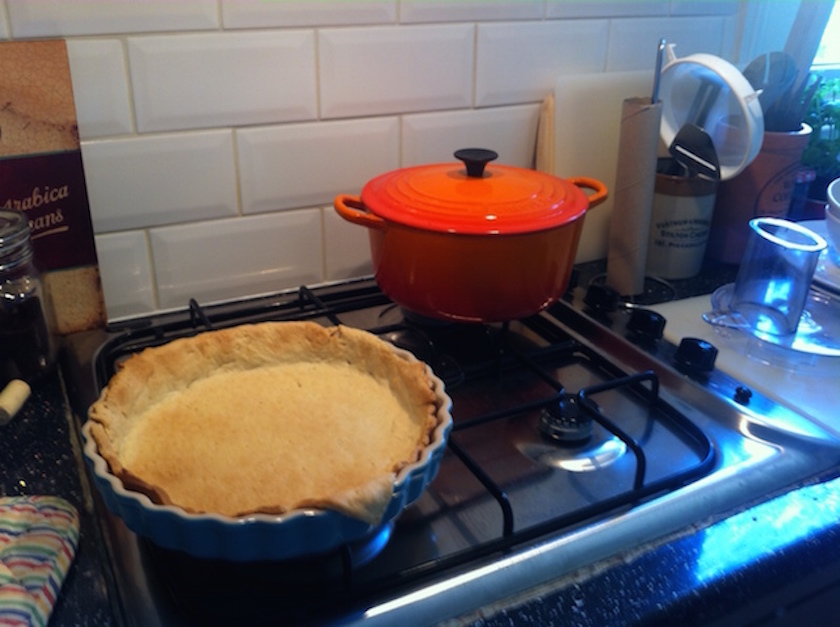
Just baked pastry...

Just baked pastry…

For the pastry: Make the shortcrust pastry according to your favourite recipe, or purchase store bought. Pop it in your pie dish, line with baking paper and pour in baking beans (or ball bearings, dried chickpeas – whatever you have to hand) and bake for 15 minutes. Then take it out of the oven, remove the beans and baking paper, and return to the oven for a further 5 minutes. Keep an eye on this though – you don’t want it to burn.

A note on the pastry cooking time: since the fully assembled pie itself only bakes for 10 minutes total, I thought it was a good idea to bake for an extra 5 minutes to make sure the pie crust wasn’t soggy or undercooked. I baked it at 200°C.

Then pour in the prepared lemon curd mixture and spoon over the whipped egg whites. Don’t be tidy about this – haphazardly spooning the meringue results in wonderful tufts and peaks that give the finished pie character and a great golden colour once it’s baked.

Ta daa!!! Lemon meringue pie!

Ta daa!!! Lemon meringue pie!

Then pop the assembled pie in the oven for 10 minutes (or until golden) and voila! Lemon meringue pie.

You then have to find the fortitude to avoid scoffing the entire thing right then and there. It smells wonderful, and looks cracking. Then again, why not? Who’s going to stop the cook tucking in first?
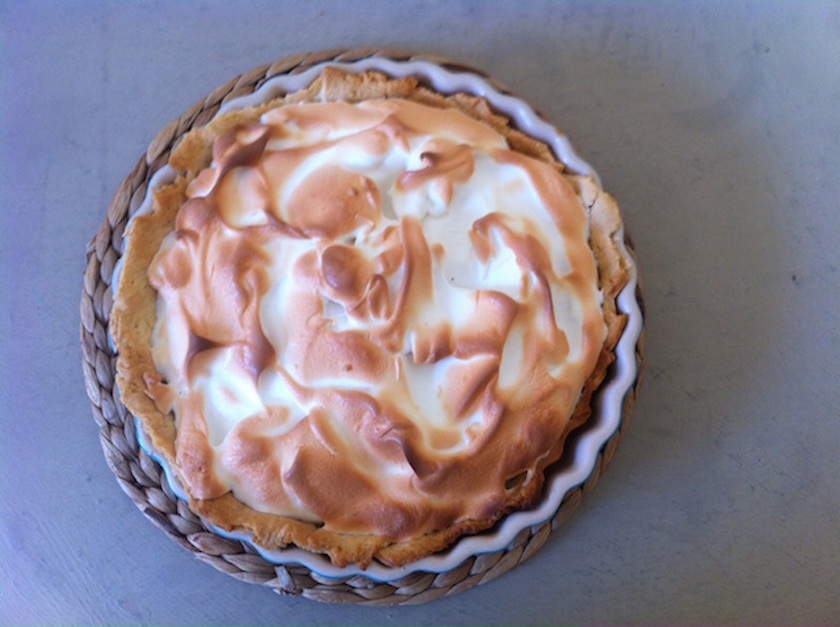
photo 4

A white wine with citrussy notes would go wonderfully with this, if you ask me – if only to raise a toast to the late, great Maya Angelou and her wonderful writing and delicious food stuffs.

Header image © Troy Toller/Flickr. All others are mine.

seafood linguine

Today was not a day for Basics spaghetti. Don’t get me wrong – some days are absolutely that, I would be the first to recommend it – when the spaghetti gets buried, perfectly crushed under the weight of a rich tomato sauce and lashings of cheddar. But today was not that day.

Today was a day that started with hitting snooze for an hour. A whole hour. Followed by a day of work, which, granted, was not as bad as J’s work day, but still was hefty on the “suck” factor. In fact, because the day was what it was, I know that today is a day for linguine. De Cecco linguine. Tossed about in a light, but buttery sauce, made with shallots, garlic, lifted by parsley, before being drenched in a pale, dry rose, peppered with bright, cherry tomatoes and finally assaulted by king prawns. Maybe even some other crustaceans and other creatures of the deep. It’s that kind of day.

All of which will be served with the aforementioned wine. Lots of it. And hopefully life will feel better again.

Cooking can magically do that, I find. It’s meditative, fun, and (sometimes) quite challenging, and – most importantly of all – you get treats along the way. Also, I exert what J has started referring to as “The Chef’s Tithe”, which is basically a very gentlemanly way of saying I get to eat everything along the way, and most likely get a bigger portion when it’s done. As I said, cooking is awesome.

For the magic “day improving” pasta, you need a few key ingredients:

photo-2

Having made this before (in March) – this is the sauce with mussels, clams, and one helluva giant prawn

WINE
BUTTER
CHERRY TOMATOES
OLIVE OIL

Ooh, it makes me happier just looking at that list. You also need garlic, shallots, some kind of herb (I’d recommend parsley or basil), a whisk and, of course, prawns and other creatures. I’d opt for raw prawns, if I were you – damn easy to tell when they’re done and damn tasty when freshly cooked.

So get the water boiling for your linguine – the sauce will take about as long as the pasta takes to cook. Heat up your pan and when hot, chuck in some olive oil, followed by the cherry toms. The trick is to get them to pop and burst out of their skins (this will be a silky sauce – sans skins – so remove them as you go). Let the toms heat up and you’ll notice the tell-tale seams starting to appear. Leave them to it and make sure you have the wine and butter to hand. Throw in some finely diced garlic and shallots and let them soften – keep an eye on them, you don’t want them to brown, just soften. (Adding a pinch of salt will help the softening process immeasurably.)

While you’re stirring and watching (also known as “cooking”) lift out the skins – with some kind of implement, not your fingers, please. Might require a bit of teasing away from the tomato, but it will be worth it, I promise.

Pour in some wine – enjoy the hiss – and then immediately add a few nobs of butter to the pan and whisk it enthusiastically to create a kind of emulsion. Go ahead – slide some more butter in. You only live once. Your sauce will now be taking shape – have a little taste and add seasoning (e.g. good quality salt, pepper – even a few chilli flakes if you like the heat).

When it tastes right to you – and by “right” I mean tomatoe-y and buttery and wine-y and delicious – add your seafood and herbs. Parsley or basil would both work really well here. I like to add raw prawns so the minute they turned pink – ping! – supper’s ready. All that’s left is to add the cooked linguine, with a splash of the cooking water, gave it a good old toss and VOILA! But you could also add clams or mussels.

If you’re using our shellfishy friends, add them to the pan before the prawns. Once they’re in, give it a nice toss, then put the lid on to encourage them to open up and cook. Remember – wash them thoroughly first and discard any that are open.

Give the pan a shake from time to time (clams and mussels will only take a few minutes to cook), then take the lid off, throw in the prawns and follow the above.

A little squeeze of lemon would be nice in this too – give it a bit of a lift.

Serve with white or rose wine (depending on what you opted for in the dish – personally, my Chef’s Tithe applies to the wine, too – meaning that the original bottle doesn’t always make it to the table. For this reason, I recommend always having a second bottle waiting in the wings) and pleasant company.

Simple! And I’m already happier just writing about it – now, to eat it.

Header image © junpinson/iStock/Thinkstock

the joy of an aperol spritz

I was in Italy last year. It was a spur of the moment, run away from reality, throw yourself into life kind of trip. Change was happening and life was full of possibility. So, obviously, I wanted to go somewhere to properly experience the feeling. Since Italy is my happy place, off we went.

J and I started in Bologna. Land of ragù. We expected to drown ourselves in olive oil and local wine, indulge in far too much pasta, and knock back rich, bitter espresso when we got footsore.

What we did not expect was… the Aperol spritz. Having now imbibed more Aperol spritzes than I care to mention, I can tell you that the drink tastes like warm summer evenings and destination-less strolling through cobbled streets, ducking into monasteries to escape sudden rain storms. Sauntering into luxurious hotel bars and pretending I belonged. But most of all, every time I drink one, I feel happy. It’s a kind of deep breath, light-hearted happy. And I thoroughly recommend it.

But before I tried one it was just a violently orange drink people were drinking in the early evening in Bologna while nibbling snacks. Intriguing, yes, but that’s about it.

There are few drinks I won’t try though, especially if they come with snacks. Although, to be totally honest with you, dear reader, there is one drink that continues to elude me – Pimms. Surprising, I know (I’ve been told by, well, everyone I know that I’m wrong). This is, after all, a drink where the snacks have jumped the gun and got freaky with the drink, thereby removing the need for me to choose between what to put in my mouth first; it all goes in. And yet (and apologies in advance to Pimms-loving readers) all I see is brown stuff thinned out by bubbly, sickly lemonade, swirled around with fruit and assorted chunks of veg… It’s not for me.

Now, as an English woman, I feel at this point like I’m going to be asked to surrender my umbrella and my Mary Poppins-esque commuter handbag and be marched to Calais to be pushed out to sea; I may as well have just mooned the Union Jack. But there we have it. As we’re now firmly in the English-pretending-its-summer-even-though-it’s-cold-and-raining part of the year, I suspect I will go through the usual dance of “No, I won’t have one – really, no, thank you” and have to explain, yet again, that I DO NOT LIKE PIMMS. Even to friends who have known me for years (YEARS) and who have never seen me touch the stuff. I almost feel bad now… They all look so hurt and surprised at my Pimms-less existence. But you know what? This year I may take a new tact. I’ll just bite the bullet and drink all the Pimms. HA! Now no one can have any. Conversation over, bitches.

But I digress.

Those first Aperol spritzes arrived at our table, which was wobbling merrily on the cobbles, with a jaunty straw, plus a plate for nibbles, and… BAM. The holiday immediately got bumped up to stratospheric levels of awesome.

I’d go on, but there’s so much more to be said on the Aperol spritz, so much in fact that I’ll keep this brief in hopes that you bear with me in future. So, without further ado – here’s how you make an Aperol spritz (and if you don’t believe me, you’ll notice that this is the exact same recipe written on your brand new bottle of Aperol):

3 parts prosecco
2 parts Aperol
1 parts soda water
Slice of orange
Plenty of ice

Combine, enjoy, and thank me later.

Quick word on the “parts” bit of the above – can be as simple as a shot glass or, if you’re having a hard core day, espresso cup measures. Personally, I have a giant wine glass, graciously bestowed on me by my little brother, which I am itching to try out; it’s bigger than my head. I would use a measuring jug to measure out the “parts” for that glass.